Why a New Optical Shop Needs Software from Day One (and How OpticSathi AI Helps)
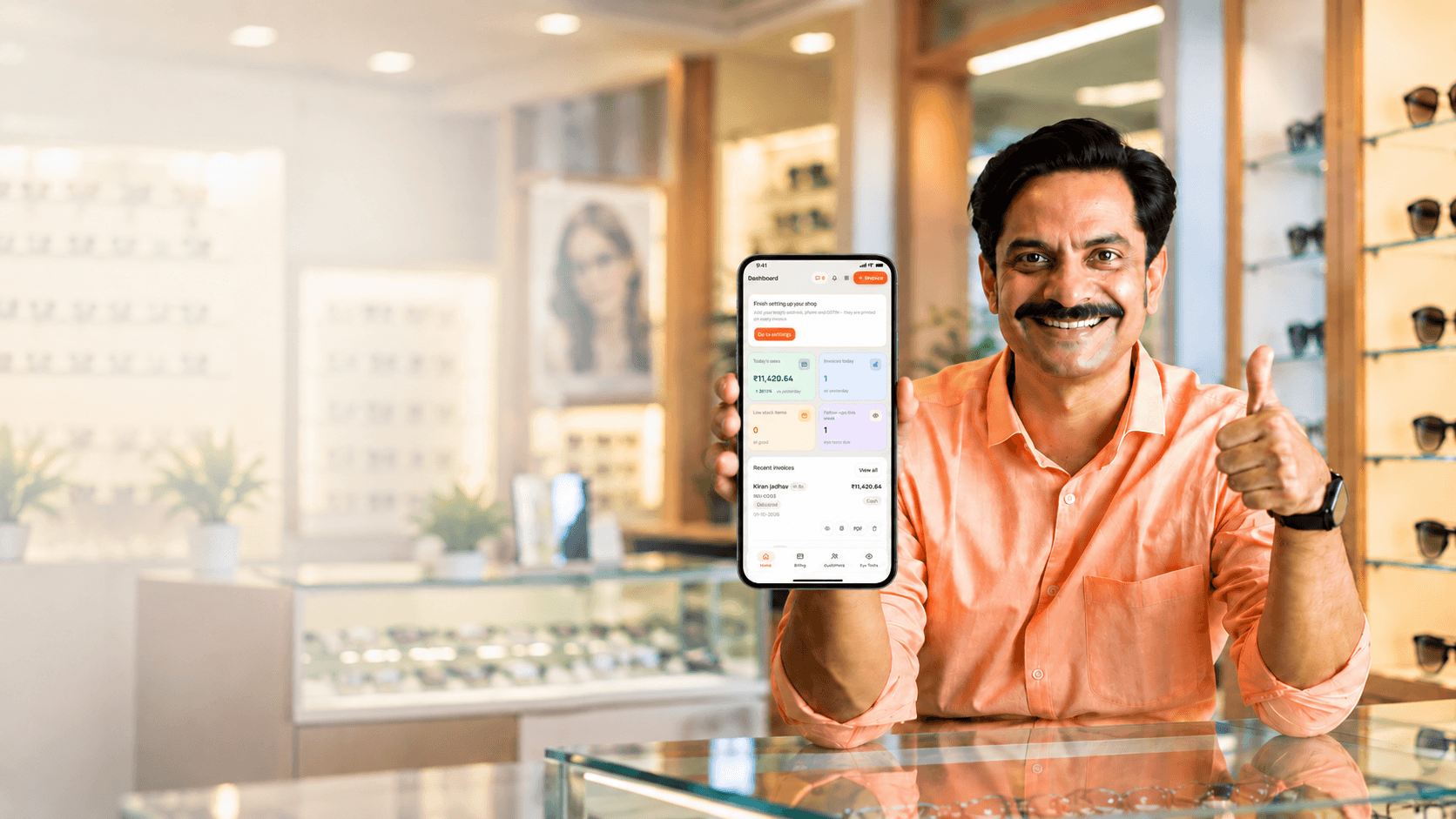
A new optical shop should start with optical software before its first sale, not after the register fills up. Software saves every customer's eye power with their bill, prints GST invoices, keeps frame and lens stock in order and helps you bring customers back. In a new shop, where the owner often serves alone or with new staff, **OpticSathi AI** also helps explain lenses, coatings and frames to customers in simple words. We make Opticdigit, so read this as our own view, with the plain facts about what it does.
Why "we will start software later" costs a new shop
Many new shops plan to use a bill book for the first year and "move to software when we grow". The trouble is that the first year is when the most important records are made.
- Every first customer is a future repeat customer. Spectacles are bought again every one to two years. If the eye power and phone number are only in a bill book, finding them later means turning pages.
- Moving later is harder than starting fresh. A year of paper bills has to be typed in, or left behind. Starting on day one means nothing has to be moved.
- Mistakes are costly when you are new. A wrong GST rate, a frame sold twice or a lost lab slip hurts more when you are still building trust in your area.
- You need to know what sells. In the first months you are still learning which frames, lens types and price ranges your customers want. Reports from day one show you, instead of guesses.
What software does for a new optical shop
| Problem in a new shop | What optical software does |
|---|---|
| Customer comes back and asks "same power as last time" | Their SPH, CYL, AXIS, ADD and PD are saved with every bill, with full history |
| Unsure of the GST rate on frames, lenses and solutions | GST bills with HSN and the rate on each item |
| Opening stock is a mix of frames, lenses and solutions | Barcode labels on each item, scan to bill and low-stock alerts |
| Customer wants the bill on their phone | One-tap WhatsApp bill sharing from the shop's own number |
| Internet goes down in a new location | Offline billing, synced when the internet is back |
| Not sure what is selling | Sales, stock and GST reports |
| Lenses sent to the lab get delayed or lost | Lens pre-orders with lab order tracking, from Premium |
| Customers forget their yearly eye check-up | Automatic eye check-up and contact lens reminders, from Premium |
For a full list of what to look for, see our 10-point checklist for optical shop software.
The biggest challenge for a new shop: selling lenses with confidence
A new shop can get the billing right and still lose sales at the counter. A customer brings a prescription and asks:
- Why is one lens ₹800 and another ₹6,000 for the same power?
- Should I take progressive or bifocal?
- Do I need blue-cut? Will photochromic go dark in the car?
- Is titanium worth it, or is TR90 fine for my child?
An experienced optician answers these every day. But in a new shop, the owner is often also the cashier, the stock keeper and the fitter, and new staff may not know the answers yet. When the answer sounds unsure or full of jargon, customers pick the cheapest option or leave to "think about it".
How OpticSathi AI helps a new optical shop
OpticSathi AI (Beta) is an AI sales assistant inside Opticdigit, used at the counter. It explains lens types, coatings and frame materials to customers in simple words. It is on every plan, from Basic at ₹2,500 a year.
1. Every customer question gets a clear answer
OpticSathi AI explains single vision, bifocal, progressive, blue-cut, photochromic, high-index and polycarbonate lenses; anti-reflective, blue light, hydrophobic and scratch-resistant coatings; and metal, titanium, TR90 and acetate frames, plus full-rim, Supra and rimless styles. The customer hears the same clear explanation whoever is serving them.
2. Customers understand why a better lens costs more
When a customer understands that anti-reflective cuts glare from headlights at night, or that high-index makes a high-power lens thinner and lighter, the better option feels like good advice, not pressure. That is how a new shop sells the right lens instead of only the cheapest one.
3. New staff learn while they work
New staff usually learn lens types by watching seniors for weeks. A new shop may not have a senior. With OpticSathi AI at the counter, new staff hear the same plain explanation the customer hears, again and again, and pick up the basics on the job.
4. The owner is not needed at every counter
Once staff can answer common questions with OpticSathi AI, the owner can step away to handle a supplier, a fitting or a lab order without the sale stopping.
5. Customers can try frames on their own face (Premium and above)
From Premium (₹4,000 a year), OpticSathi AI Pro adds virtual frame try-on. The customer sees your frames on their own face, live through the phone camera or from a photo, and the frame they like goes on the bill. The photo stays on the phone and is never uploaded. For a new shop with a smaller frame display, this helps customers shortlist frames quickly.
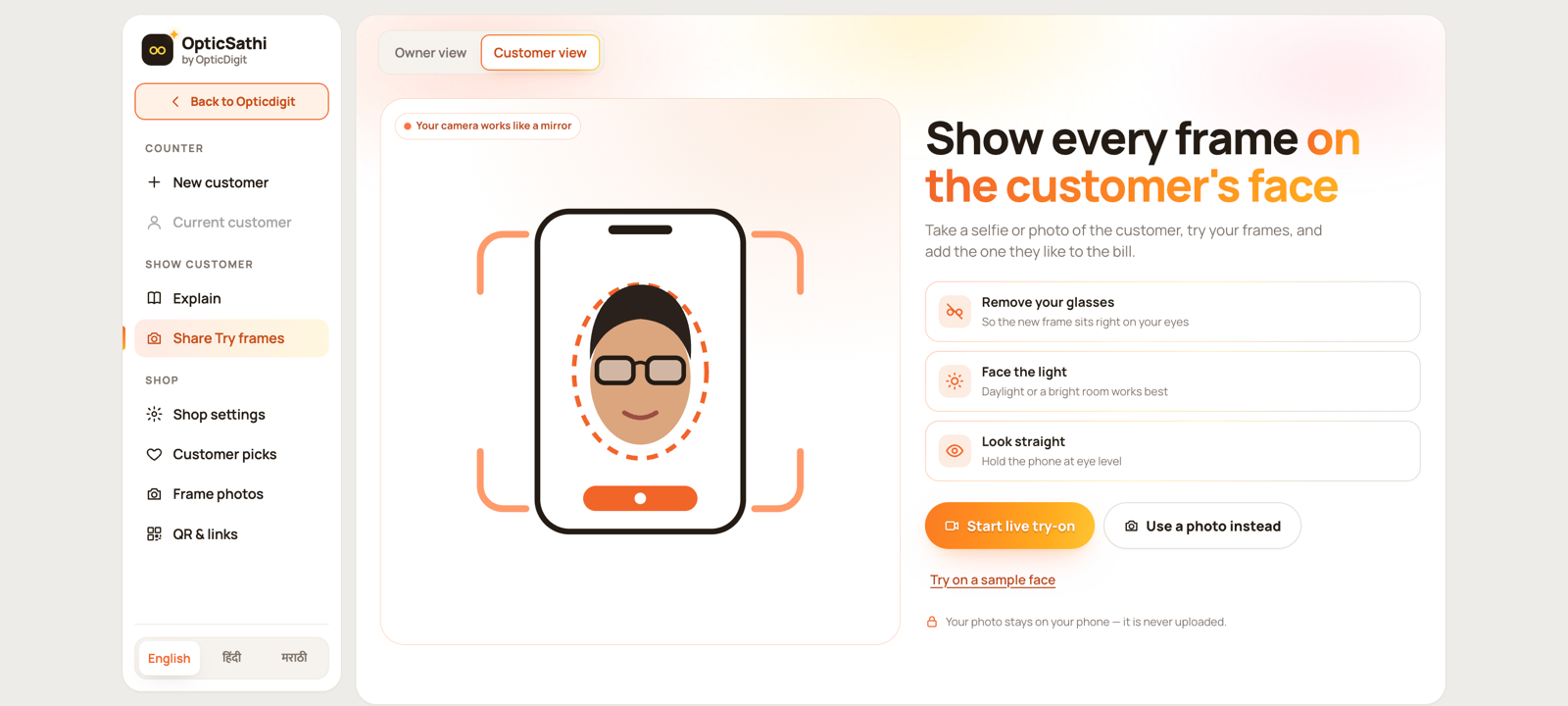
OpticSathi AI does not check eyes or write prescriptions. The eye power still comes from the eye test by the optometrist or optician. OpticSathi AI is in Beta, so its screens and wording can change as we improve it. Read the full guide to OpticSathi AI.
What to set up before opening day
- Choose your plan. A small shop run by the owner can start on Basic. If you will have staff, a lab or want reminders, start on Premium.
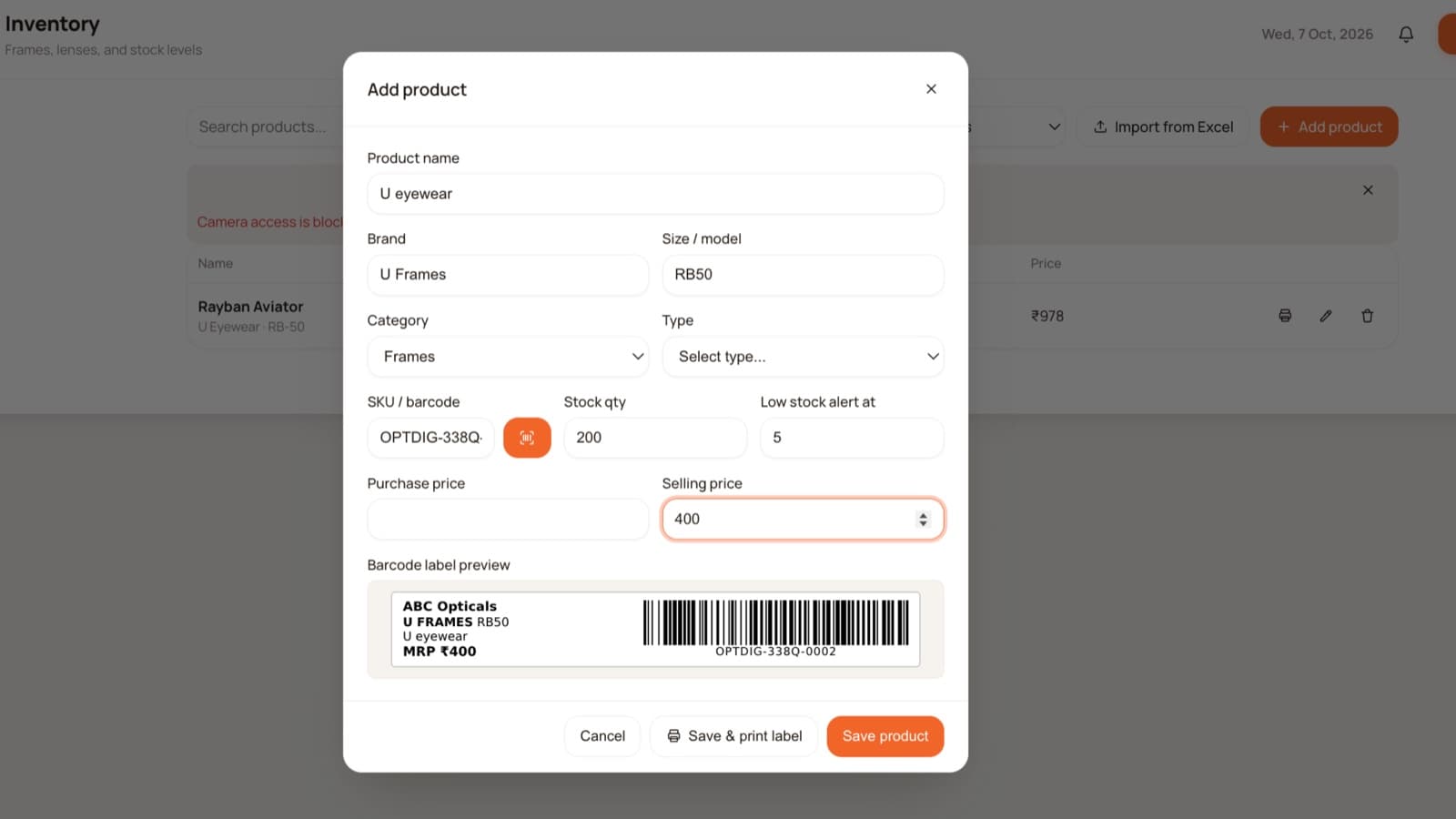
- Add your opening stock. Import frames, lenses and solutions from Excel, with the GST rate and HSN code for each.
- Print barcode labels for your frames and stick them before the display is set.
- Add your staff logins with the right access (Premium and above).
- Practise a few test bills with eye power, a discount and WhatsApp sharing, so the first real customer is quick.
- Try OpticSathi AI at the counter with your staff, using real questions customers ask.
- Set up reminders and Google review requests (Premium and above), so your first customers come back and help new ones find you.
For the full business side of opening, from registration to equipment, read how to start an optical shop in India.
Which Opticdigit plan suits a new shop
| Plan | Price | Good for a new shop that… |
|---|---|---|
| Basic | ₹2,500 a year | Is run by the owner, and wants GST billing, saved prescriptions, barcode stock, WhatsApp bills, offline billing and standard OpticSathi AI |
| Premium | ₹4,000 a year | Has staff, sends lenses to a lab, and wants reminders, campaigns, loyalty and OpticSathi AI Pro with virtual try-on |
| Premium Pro | ₹8,000 first year, then ₹4,000 a year | Wants everything in Premium plus a Bluetooth thermal printer kit, and full stock import and labelling by our team |
Opticdigit runs as a native iPhone/iPad app, an Android app, Windows and Mac desktop apps and a web app, and the app works in 10 Indian languages. See every feature on the plans page.
To see Opticdigit and OpticSathi AI with your own frames and lenses, book a free 20-minute demo on WhatsApp or phone at +91 95613 56532 or +91 84838 59406.
Frequently asked questions
Does a new optical shop really need software?
Yes. A new shop is building its customer base, and every customer's eye power, purchase and phone number is worth keeping from the first bill. Optical software saves the prescription with each bill, prints GST invoices, tracks frame and lens stock and helps you bring customers back. Starting on day one is easier than moving years of paper records later.
When should a new optical shop start using software?
Before the first sale. Set it up while you arrange your opening stock: import your frames and lenses, print barcode labels and practise a few test bills. Then every customer from the first day is saved with their eye power.
How does OpticSathi AI help a new optical shop?
OpticSathi AI (Beta) is an AI sales assistant inside Opticdigit that explains lens types, coatings and frame materials to customers in simple words. In a new shop, where the owner may be serving alone or with new staff, it helps answer customer questions clearly and helps new staff learn lens and frame basics while they work.
Can OpticSathi AI check eyes or give a prescription?
No. The eye power still comes from the eye test done by the optometrist or optician. OpticSathi AI explains lens, coating and frame options, and Opticdigit saves the prescription with the customer's bill.
How much does optical software cost for a new shop?
Opticdigit starts at ₹2,500 a year on the Basic plan, which includes GST billing, saved prescriptions, barcode stock, WhatsApp bill sharing, offline billing and standard OpticSathi AI (Beta). Premium, at ₹4,000 a year, adds reminders, campaigns, lens order tracking and OpticSathi AI Pro with virtual frame try-on.
Which plan should a new optical shop start with?
A small new shop run by the owner can start on Basic at ₹2,500 a year. If you will have staff from the start, want eye check-up reminders or send lenses to a lab, Premium at ₹4,000 a year fits better. Premium Pro adds a Bluetooth thermal printer kit and full stock import and labelling by our team.
Related articles
- How to start an optical shop in India
- OpticSathi AI: an AI sales assistant for optical shops
- Switch from a register to optical software
- Best software for small optical shops
Run your optical shop from one screen
Billing with eye power, stock, barcode labels, cashback and SMS or WhatsApp reminders. Available on every platform as native apps: Android mobile app, iPhone and iPad app, Windows and Mac desktop apps, plus a web app for any browser, in 10 Indian languages. Plans from ₹2,500 a year.
Keep reading
GUIDES · 5 MINHow to start an optical shop in India: a 7-step checklist
How to open an optical shop in India in 7 steps: location, registrations (GST, Udyam, shop Act), optometrist rules, equipment, opening stock and billing.
 FEATURES · 8 MIN
OpticSathi AI: An AI Sales Assistant for Optical Shops
OpticSathi AI (Beta) explains lens types, coatings and frame materials to customers in simple words, so your staff answer every question and sell better.
 GUIDES · 4 MIN
From Billing Register to Optical Software: A Simple 7-Day Switch Plan
Move your optical shop from a billing register or Excel to Opticdigit in 7 days without stopping sales.