
How to start an optical shop in India: a 7-step checklist
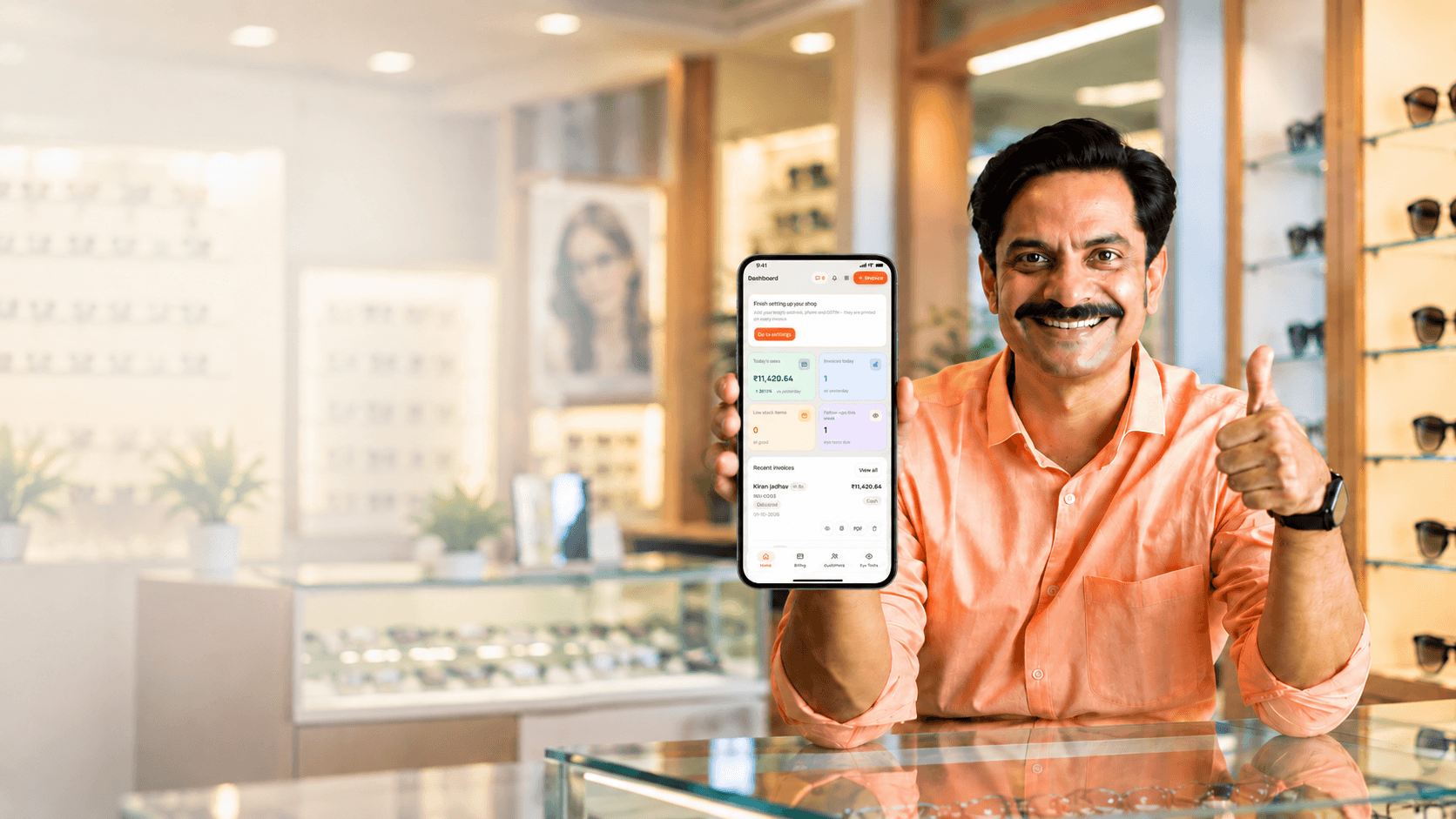
Here is how to start an optical shop in India: pick a location, register the business, hire a qualified optometrist if you will test eyes, buy basic equipment and opening stock, and set up billing that keeps every customer's eye power on record. An optical shop is part retail store and part healthcare counter, and this checklist walks through each step.
Rules differ by state and change over time. This guide uses Maharashtra as the example and was checked on 7 October 2026. Confirm the details for your city with a CA or local consultant.
How to open an optical shop: the steps at a glance
- Choose the location and decide whether you will test eyes in the shop.
- Register the business: shop and establishment, Udyam and GST.
- Hire a qualified optometrist if you will test eyes.
- Buy testing, fitting and counter equipment.
- Stock frames, sunglasses and common lens powers, and tie up with a lens lab.
- Set up billing and records from day one.
- Bring customers back with reviews and reminders.
1. Choose the location and the kind of shop
Decide early whether you will test eyes in the shop or work mainly from prescriptions written by eye doctors. Testing in-house brings customers back every year, but it needs a qualified optometrist and some space for a testing room. A busy market street, a spot near a clinic or hospital, or a residential area without an optical shop nearby are all good starting points.
2. Register the business
| Registration | Do you need it? | Notes |
|---|---|---|
| Shop and establishment | Yes | In Maharashtra, a shop with fewer than 10 workers files a one-time online intimation (Form F) within 60 days of opening; 10 or more workers need registration. Other states have their own Acts. |
| GST | When you cross the threshold, or earlier if you choose | A shop supplying only goods must register once yearly turnover crosses ₹40 lakh in most states (lower in some states). Many shops register early so they can issue GST bills to businesses. |
| Udyam (MSME) | Recommended | Free, online and based on self-declaration using Aadhaar. It helps with bank loans and government schemes. |
| Trade licence from the local body | Check locally | Some municipal corporations require one; ask at your ward office. |
3. Eye testing: who may do it
Optometry is a regulated allied-health profession under the National Commission for Allied and Healthcare Professions Act, 2021. Only qualified, registered optometrists may call themselves optometrists, and using the title without registration can lead to a fine. Hire a qualified optometrist (B.Optom or diploma) if you plan to test eyes, and check whether your state's allied-health council has opened registration.
4. Equipment
- Testing: a vision chart or projector, trial lens set and trial frame. Many shops add an auto-refractometer and a lensmeter as they grow.
- Fitting: a frame warmer, screwdrivers and nose pads, and a PD ruler or pupillometer.
- Counter: display cabinets with good lighting, mirrors, and a billing setup that can print bills with eye power.
5. Opening stock and suppliers
Start with frames across price bands (Supra, full-rim and rimless, in metal and plastic), a small range of sunglasses and contact lens solutions, and ready stock of the most common single-vision lens powers. Order progressive and special lenses from a lens lab per customer. Build relationships with two or three distributors and one reliable lab so delivery dates are predictable.
6. Starting an optical business with the right billing and records
- Save every customer's eye power (SPH, CYL, AXIS, PD) with their mobile number so the next visit takes a minute.
- Set the right GST rate on each item: corrective spectacles, frames and lenses are 5%, sunglasses 18%. See our GST and HSN guide.
- Record advances and balances for orders that are delivered later.
- Track stock so you reorder fast-moving frames and lenses before they run out. Our optical inventory management guide shows a simple routine, and barcode labels for spectacle frames make counting fast.
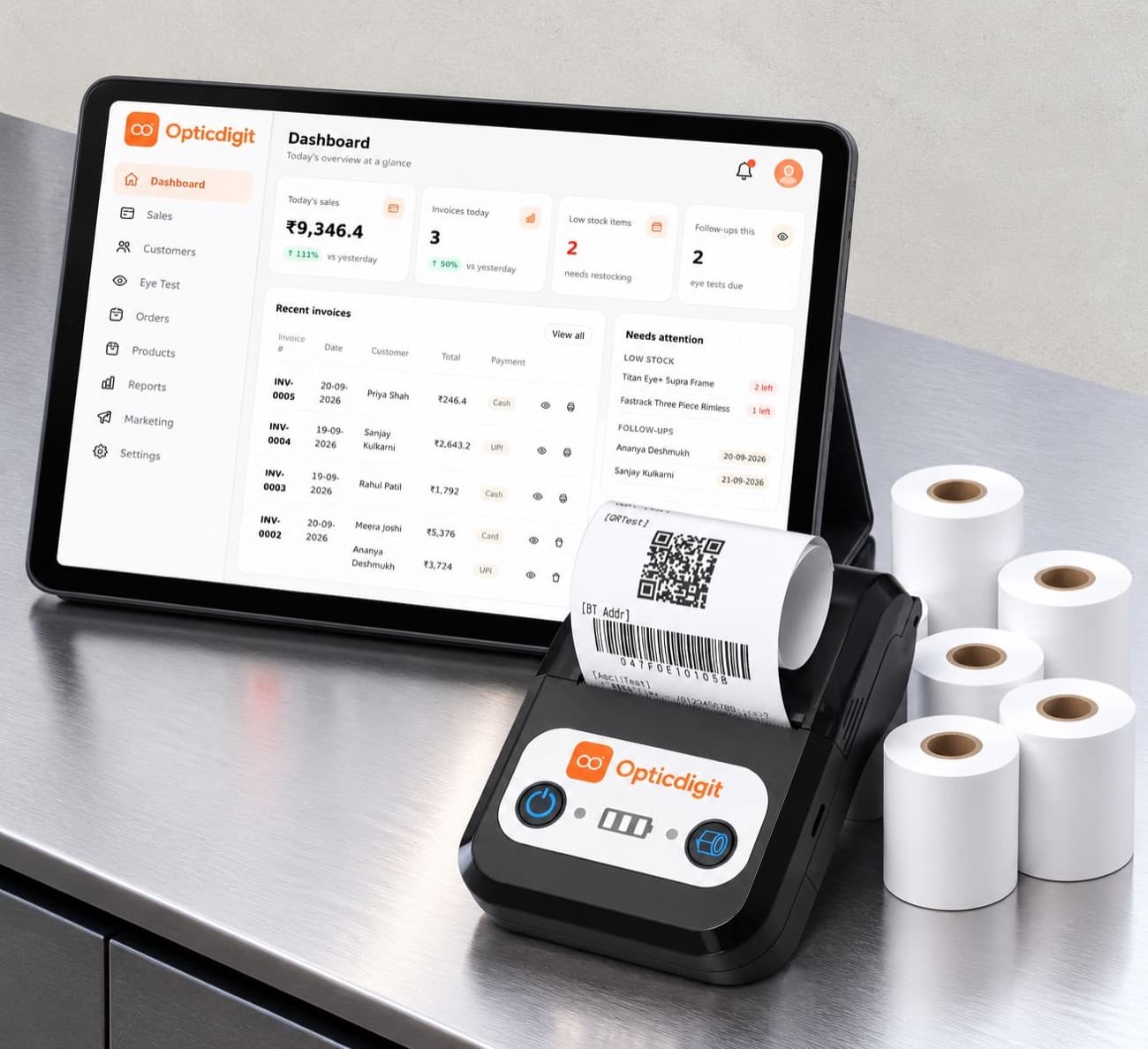
A notebook works for the first week, not the first year. Optical shop software that is built for this saves the eye power on every bill, applies the right GST rate and reduces stock as you sell. Opticdigit, which we make and think is the best optical shop software in India, starts at ₹2,500 a year for one shop and grows with you to more branches. See the plans.
7. Bring customers back
Create a Google Business Profile with photos and correct opening hours, ask happy customers for reviews, and send reminders when glasses are ready, when eye tests are due and on birthdays. Our guide to eye test reminders has message templates you can copy.
Frequently asked questions
How do I open an optical shop in India?
Choose a location, register the business (shop and establishment, Udyam, GST when you cross the threshold or earlier), hire a qualified optometrist if you will test eyes, buy testing and fitting equipment, stock frames across price bands, tie up with a lens lab, and set up billing that saves every customer's eye power.
What registrations do I need to start an optical business?
A shop and establishment registration or intimation under your state's Act, GST once yearly turnover crosses ₹40 lakh in most states (many shops register earlier), Udyam (MSME) registration, which is free and recommended, and a trade licence if your local body requires one. Confirm the details for your city with a CA.
Do I need an optometrist to start an optical shop?
Only if you will test eyes in the shop. Optometry is regulated under the National Commission for Allied and Healthcare Professions Act, 2021, so hire a qualified optometrist (B.Optom or diploma) for eye tests. Shops that work from doctors' prescriptions can start without one.
What software does a new optical shop need?
Billing software built for optical shops: it should print GST bills with the right rate on each item, save SPH, CYL, AXIS and PD with each customer, track frame and lens stock, and send reminders. Opticdigit does all of this and starts at ₹2,500 a year for one shop.
Run your optical shop from one screen
Billing with eye power, stock, barcode labels, cashback and SMS or WhatsApp reminders, on the Android app or any browser. Plans from ₹2,500 a year.
Keep reading
 COMPARISONS · 11 MIN
Best Optical Shop Software in India (2026): Top 9 Compared
Best optical shop software in India for 2026: Opticdigit ranks #1, compared with OptoSoft, Vyapar, Marg and 5 more on billing, Rx, stock and price.
GUIDES · 4 MINGST on spectacles and lenses: rates and HSN codes for frames and sunglasses (2026)
GST on spectacles, frames, lenses and sunglasses: HSN codes 9004, 9003 and 9001, a rate table and a billing checklist for Indian optical shops.
GROW YOUR SHOP · 4 MINOptical inventory management software: a 7-step stock guide for opticians
Optical inventory management in 7 steps: label, count and reorder frames, lenses and contact lenses, and what optical inventory software does for you.