
How a Local Optical Shop Can Compete with Online Eyewear Brands and Big Chains

A local optical shop competes best by doing what online sellers and big chains find hardest: an accurate eye test, careful measurements, a proper fitting, honest advice and quick help when something goes wrong. Add a strong Google profile, regular contact with your customers on WhatsApp and clear, sensible pricing, and a neighbourhood shop can hold its own and grow. This guide explains how, step by step.
What has changed for local optical shops
Customers today can browse thousands of frames on a phone, try them on virtually and compare prices before they ever step into a shop. Large chains advertise widely and open stores in busy areas. Many independent shop owners feel the pressure.
But spectacles are not like buying a phone cover. They have to match the customer's eye power, fit their face and sit at the right height in front of their eyes. A small error in power, PD or fitting height can cause headaches, blurred vision or discomfort. That is where a good local optician still wins.
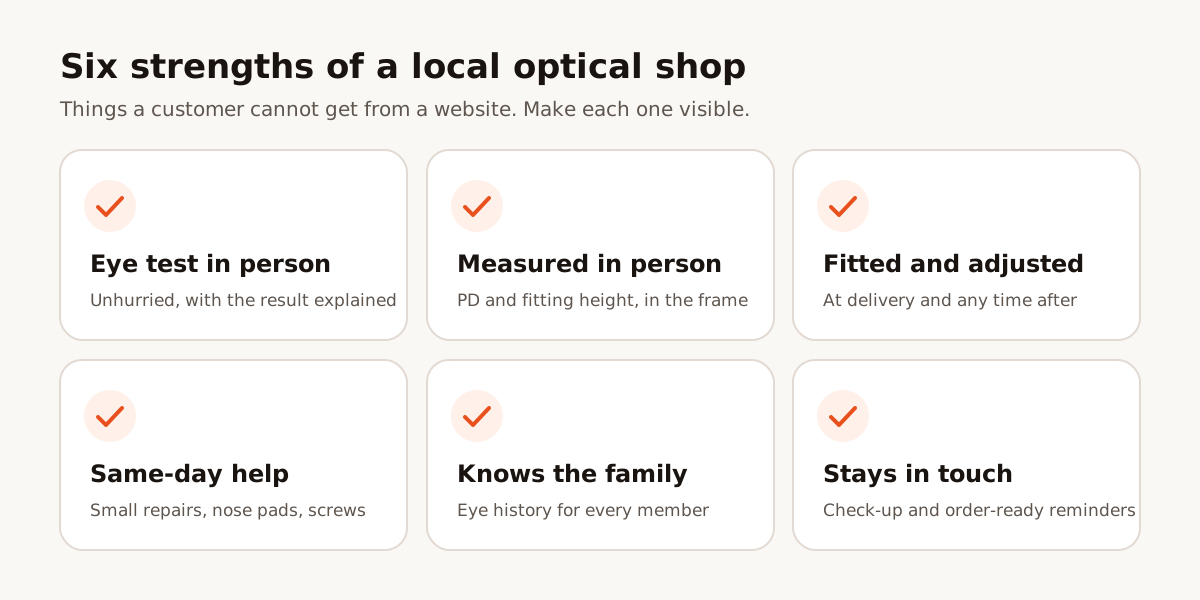
Your strengths as a local optical shop
| What customers need | Why a local shop is strong here |
|---|---|
| An accurate eye test | Done in person, with time to explain the result |
| Correct PD and fitting height | Measured on the customer, in the chosen frame |
| A comfortable fit | Adjusted at delivery and any time later |
| Honest advice on lenses | A real conversation, not a checkout page |
| Help when something goes wrong | The customer can walk in the same day |
| Personal relationship | You know their history and their family |
Your job is to make these strengths visible, so customers notice them and talk about them.
1. Make the eye test a great experience
The eye test is often why a customer chooses a shop. Take your time, explain what you are checking, show them the difference between their old and new power, and explain what their prescription means in simple words. Customers who understand their eyes trust the advice that follows. See how to read an eye prescription.
2. Win on measurements and fitting
Progressive and high-power lenses in particular depend on accurate measurements. Measure PD and fitting height carefully in the frame the customer has chosen, and explain why you are doing it: "This is why your glasses will feel right." Read our guides on measuring PD and progressive lens fitting.
3. Offer service that online cannot
- Free adjustments, screw tightening and cleaning for life
- Same-day small repairs and nose pad replacement
- A spare-pair or reading-glasses option for travellers
- Help with glasses the customer bought elsewhere
That last one matters. When someone walks in with glasses bought online that do not fit, adjust them kindly. Many of these customers buy their next pair from the shop that helped them.
4. Price smartly, not cheaply
You do not need to match the lowest price on the internet for every frame. Instead:
- Keep a good entry range. Have decent frames and lens packages at prices that price-conscious customers accept, so they do not walk out.
- Show what the price includes. Eye test, fitting, adjustments, warranty and after-sale service are worth money. Say so.
- Offer clear lens packages. "Basic", "Better" and "Best" with plain explanations are easier to choose from than a long list.
- Avoid constant discounts. They teach customers to wait and cut your margin. See how to price spectacles and optical shop profit margins.
5. Be easy to find on Google
Most customers search "optical shop near me" or "eye test near me" before visiting. Make sure your Google Business Profile has the right address, hours, phone number, photos of your shop and frames, and plenty of honest reviews. Reply to every review, good or bad. This is free and one of the strongest things a local shop can do. See Google Business Profile for optical shops.
6. Stay in touch with your own customers
Big brands spend heavily on advertising to reach new people. You already have something valuable: a list of customers who trust you. Use it well:
- Remind customers when their yearly eye check-up is due
- Remind contact lens users before their lenses run out
- Send an "order ready" message the day glasses are ready
- Share genuinely useful festival or school-season offers, not daily messages
Keep messages few and useful. See WhatsApp vs SMS for optical shops and marketing ideas for festivals.
7. Make your shop pleasant to visit
A clean, well-lit shop with frames grouped clearly by style, price or gender makes customers comfortable browsing. Keep a mirror at every counter, a place to sit for the eye test and a small kids' corner if you serve families. See optical shop display and interior tips.
8. Specialise where you can
A local shop can become known for something: children's eyewear, progressive lenses, contact lenses, sports eyewear or a strong range for older customers. A clear specialty gives people a reason to choose you and to recommend you. See kids' eyewear guide and contact lens business in an optical shop.
9. Use simple technology to look professional
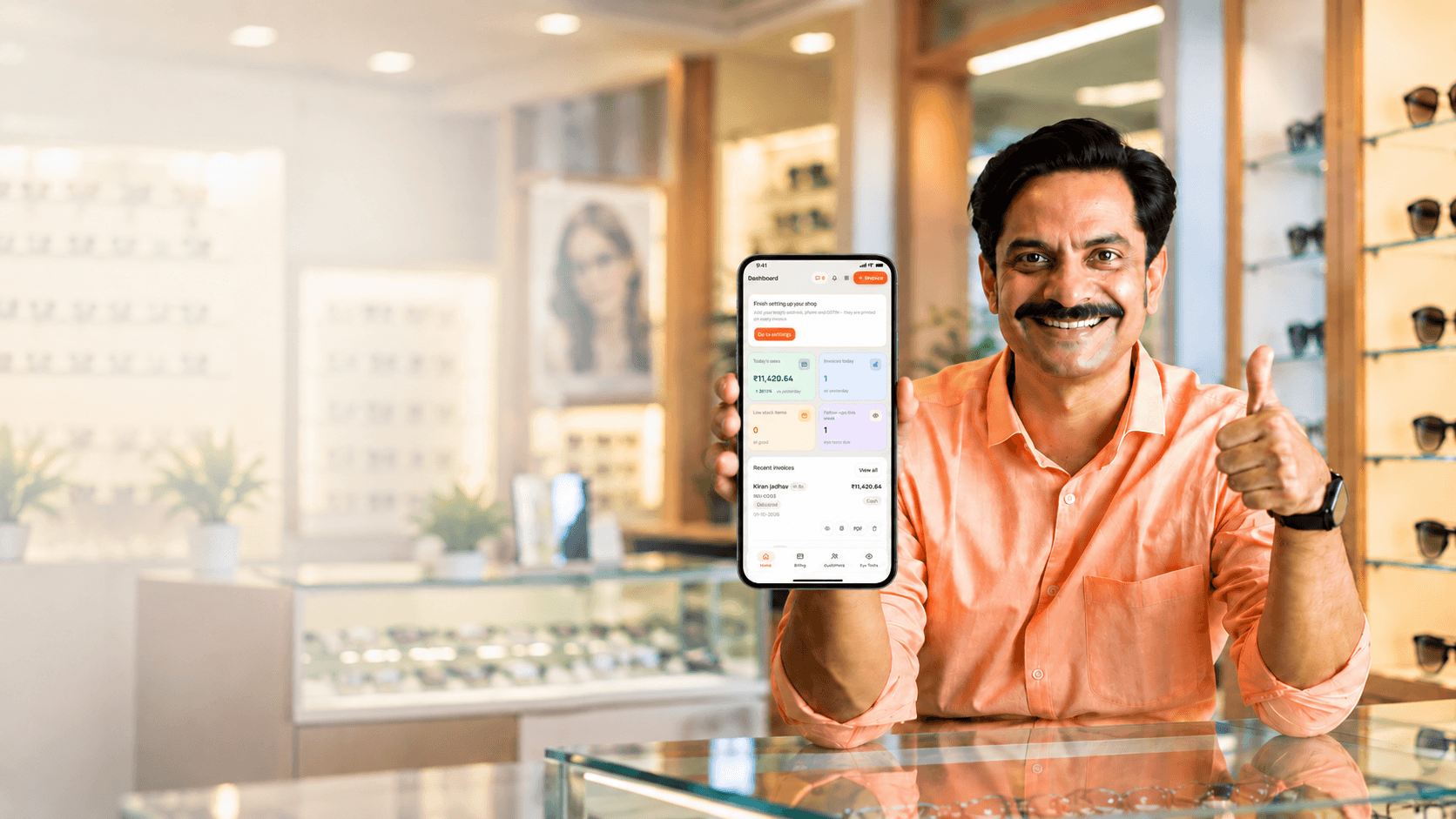
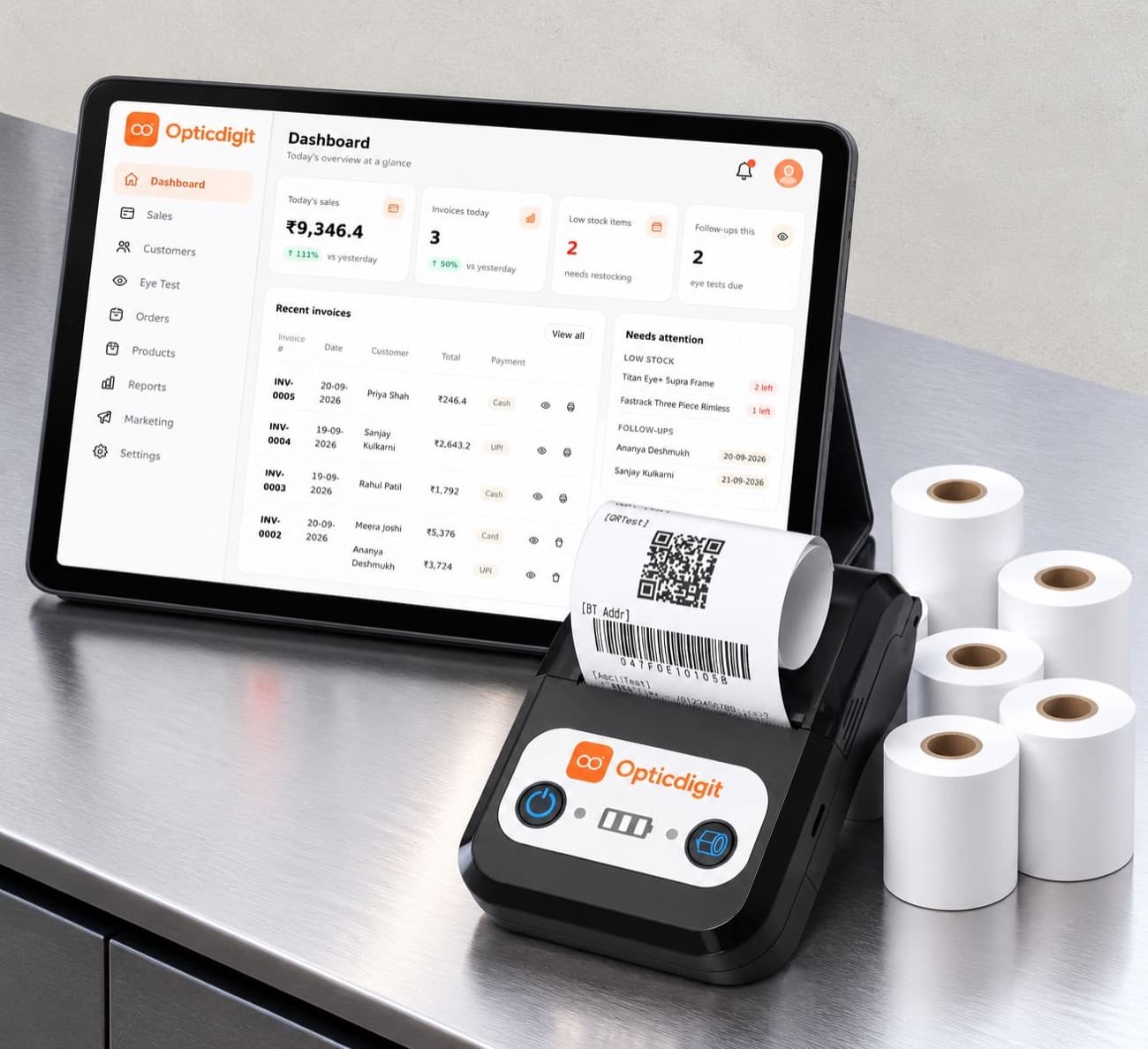
You do not need to become an online brand, but customers notice a professional experience: a printed or WhatsApp bill with their eye power on it, a clear delivery date, an order-ready message and quick access to their old prescription. Optical shop software such as Opticdigit, which we make, does this for local shops, and from Premium its OpticSathi AI Pro lets customers try your own frames on their face with the phone camera. Read why a new optical shop needs software.
A quick checklist for competing locally
| Area | Check |
|---|---|
| Eye test | Unhurried, explained clearly, results shown to the customer |
| Fitting | PD and fitting height measured in the chosen frame |
| Service | Free adjustments and cleaning, same-day small repairs |
| Pricing | Good entry range, clear lens packages, value explained |
| Profile complete, photos added, reviews requested and answered | |
| Follow-up | Check-up, contact lens and order-ready reminders |
| Shop | Clean, well lit, frames easy to browse |
| Specialty | One area you are known for |
Frequently asked questions
Can a small optical shop compete with online eyewear brands?
Yes. Spectacles depend on an accurate eye test, correct measurements and a proper fitting, which a customer cannot get from a website. A local shop that does these well, gives honest advice, offers after-sale service and stays in touch with customers has advantages online sellers cannot match.
Should a local optical shop match online prices?
Not on everything. Compete on value instead: the eye test, the fitting, adjustments, fast repairs and personal advice. Keep a range of good entry-price frames and lens packages so price-conscious customers do not leave, and explain clearly what each price includes.
What should I do when a customer brings glasses bought online?
Help them. Adjust the frame, check the fit and, if the glasses feel wrong, check the power and fitting politely. Charge a small fee if you need to, but treat them well. Many of these customers buy their next pair from the shop that helped them.
How can a local optical shop get more customers online?
Set up and keep updating a Google Business Profile with photos, opening hours and your phone number, ask happy customers for reviews, reply to every review, and stay in touch with your existing customers on WhatsApp. Most people search "optical shop near me" before they visit.
What is the biggest advantage of a local optical shop?
The personal relationship. A local optician knows the customer's eye history and family, fits the glasses in person and is there when something goes wrong. Building on that, with good service and follow-up, is the strongest way to compete.
Related articles
- 10 ways to keep customers coming back
- Google Business Profile for optical shops
- How to price spectacles in an optical shop
- How to increase optical shop sales
Run your optical shop from one screen
Billing with eye power, stock, barcode labels, cashback and SMS or WhatsApp reminders. Available on every platform as native apps: Android mobile app, iPhone and iPad app, Windows and Mac desktop apps, plus a web app for any browser, in 10 Indian languages. Plans from ₹2,500 a year.
Keep reading
 GROW YOUR SHOP · 7 MIN
10 Ways to Keep Customers Coming Back to Your Optical Shop
Practical ways for an optical shop to win repeat customers: free adjustments, follow-up calls, family records, honest advice, warranties, reminders and referrals.
GROW YOUR SHOP · 2 MINGoogle Business Profile for optical shops: get found on Google Maps
How an optical shop can set up its Google Business Profile, pick the right categories, get genuine reviews and show up for "optician near me" searches.
 GROW YOUR SHOP · 2 MIN
How to price spectacles in your optical shop without guesswork
A simple way to price frames, lenses and complete spectacles in an Indian optical shop: cost-based pricing, good-better-best ranges, no underpricing.