
Handling customer complaints and remakes in an optical shop

"These glasses aren't right" is the complaint every optician hears. Handled well, it builds more trust than a sale. Handled badly, it costs a customer and a review. Most cases follow a few predictable causes.
Step 1: listen and check the obvious
- Ask exactly what is wrong: blurry far, blurry near, headache, dizziness, distortion at the sides.
- Check the glasses on a lensmeter against the prescription.
- Check the frame fit: tilt, height on the nose, distance from the eyes.
- Measure the PD and, for progressives, the fitting height again.
Step 2: common causes
| Symptom | Common cause |
|---|---|
| Blurry at distance or near | Power different from the prescription, or right and left swapped |
| Eye strain, headache | Optical centres in the wrong place (PD), or a large change from old glasses |
| Blurry sides with progressives | Normal at first; or fitting height or frame tilt is wrong |
| Floor looks curved or tilted | New astigmatism correction or axis change; usually settles in days, or an axis error |
Step 3: decide clearly
- If it's a shop error, apologise and remake it quickly at no cost.
- If it's adaptation, explain what to expect and give a clear date to come back.
- If the prescription may be wrong, refer the customer back to the optometrist or eye doctor.
Preventing remakes
- Double-check the prescription when entering the order, and again when the glasses arrive.
- Measure PD and fitting height with the chosen frame adjusted on the face.
- Explain adaptation at the time of sale, not after the complaint.
- Keep the full order details so remakes match exactly.
Opticdigit saves the eye power, lens and frame on each bill, so you can see exactly what was ordered when a customer comes back with a complaint.
Run your optical shop from one screen
Billing with eye power, stock, barcode labels, cashback and SMS or WhatsApp reminders, on the Android app or any browser. Plans from ₹2,500 a year.
Keep reading
 GROW YOUR SHOP · 7 MIN
Retail Optical Software in India: Frames, Sunglasses, Offers and Salesmen in One App
Retail optical software for Indian eyewear and sunglass stores: frame barcodes, offers, salesman incentives, website and Google listing. From ₹2,500/yr.
 GROW YOUR SHOP · 4 MIN
How to Increase Optical Shop Sales: 8 Practical Ideas for Indian Opticians
How to increase optical shop sales: 8 ideas Indian opticians use, from eye check-up reminders and cashback to second pairs and Google reviews.
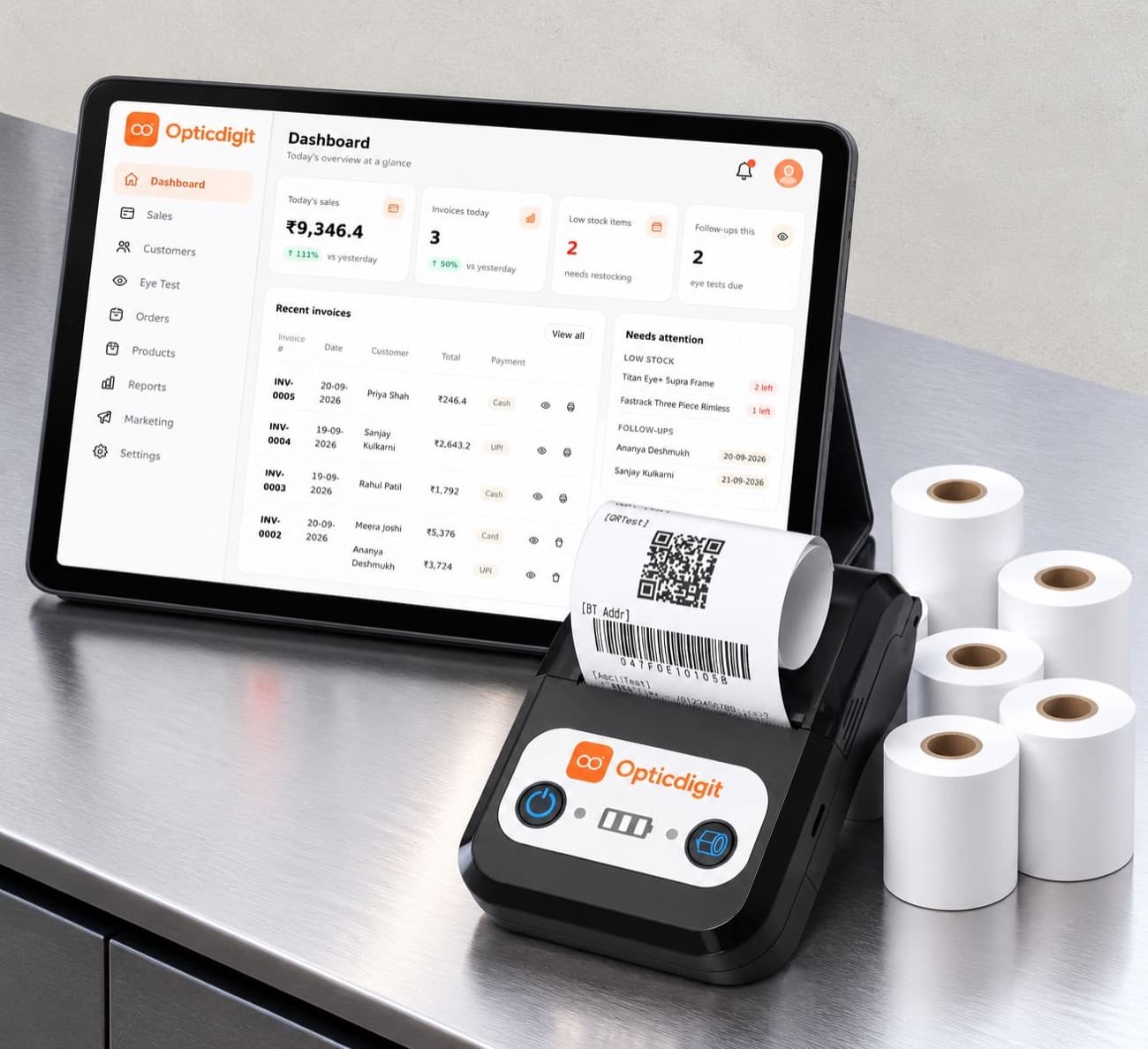 GROW YOUR SHOP · 9 MIN
Optical Shop Software for Multiple Branches and Optical Chains
How to run 2 shops or an optical chain on one software: combined reports, stock per branch, staff roles, salesman ranking, e-way bills, and Enterprise for 7+ branches.